The technical winner keeps losing.
share by 1981
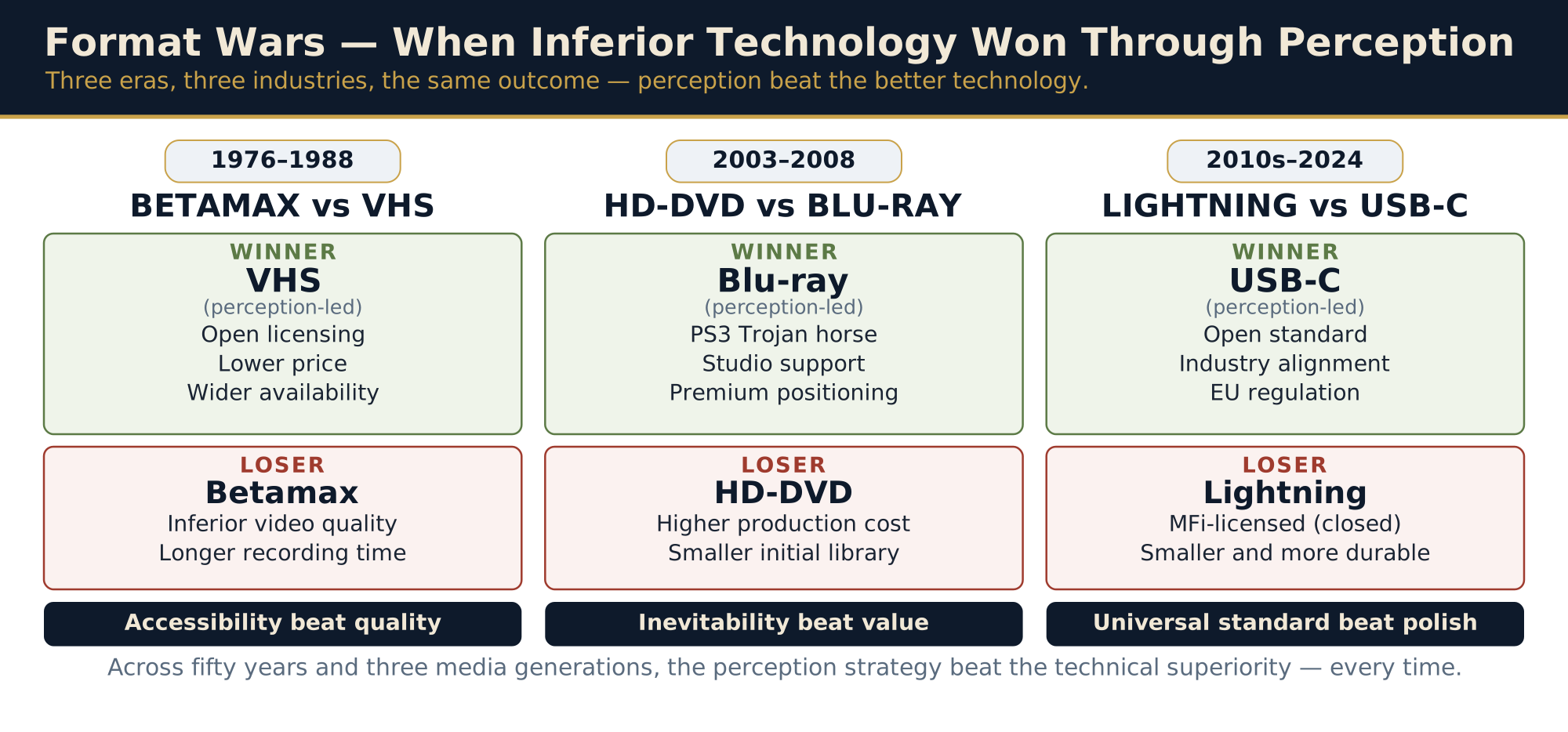
Betamax was the superior format, yet by 1988 Sony itself was building VHS units. The PS3 then shipped 10.5M Blu-ray players by 2007 — 15× HD-DVD's base; Toshiba absorbed $986M in losses.
Six spheres hold every innovation in orbit. Five in place cannot steady one that has drifted — and adoption tends to follow the drift.
Free · two minutes · no sign-upIs your innovation carrying a perception veto?
Run the checkWhy structurally sound innovations are rejected — and the operating discipline that prevents it.
Many innovations fail not from a lack of technical capability, but from a misalignment with human perception. The technical winner loses to the perception winner so consistently that the outcome can often be predicted in advance.
Perception doesn't just influence adoption. Across six spheres and ten levers, it shapes the outcome. This companion turns that claim into an instrument — a diagnosis, a prescription, a live calculator, and forty cases that make the theory operational.
Continued in The Diagnostic →
Five aligned spheres cannot overrule one misaligned. Perception holds the veto.
Read Before You Buy
The book is out. Get the preview — Chapters 1 & 2 — and a worked case breakdown every few weeks. Course news lands here first. No spam, unsubscribe anytime.
Perceptive change happens from within an industry — never against it. The work is reading the foundations, locating the boundaries, then engineering the move that the system will accept.
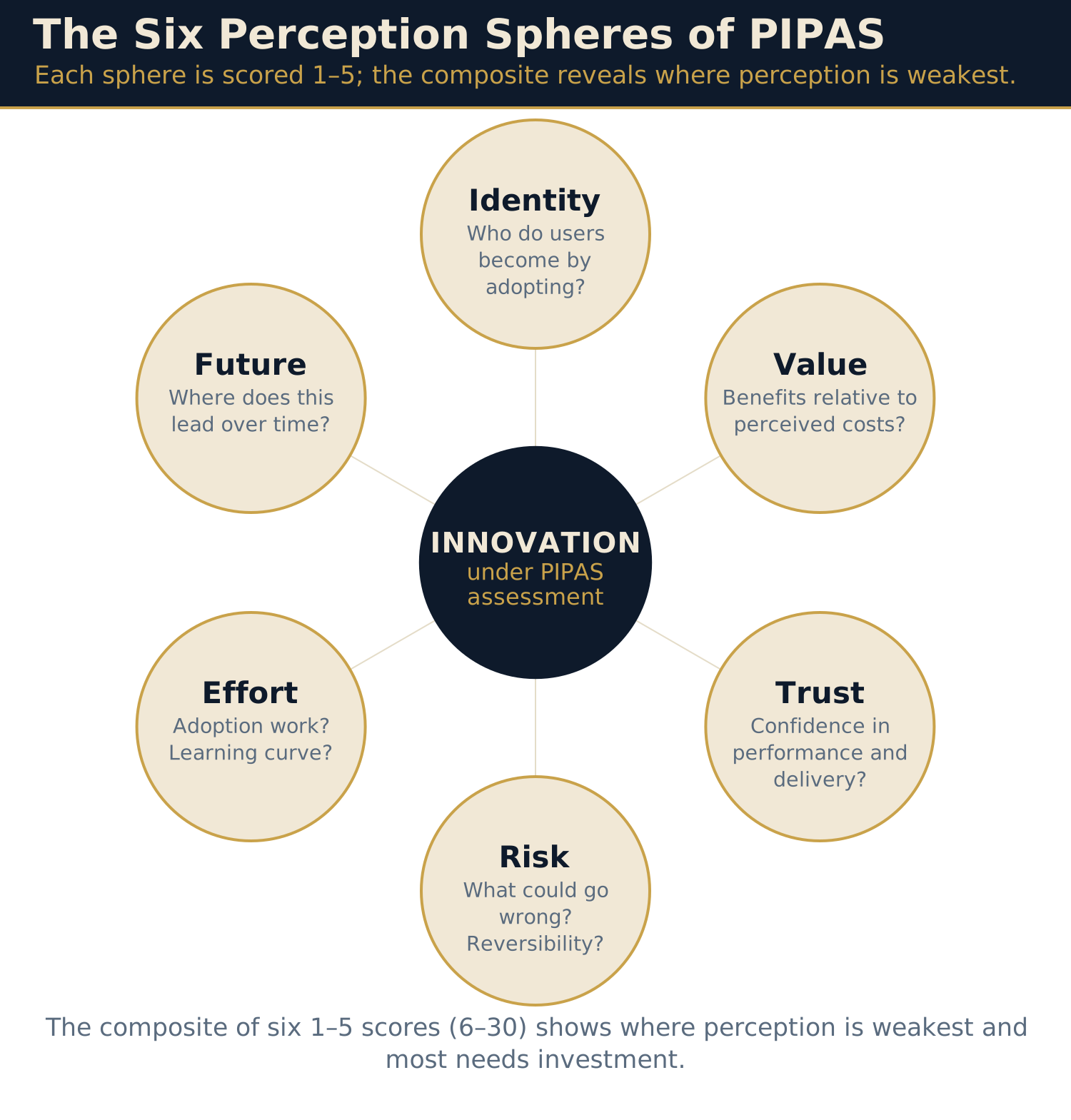
Each sphere scores 1–5; the composite, read against four empirical bands, predicts trajectory before launch. Select a sphere.
Name an innovation, score the six spheres, and read its perception-veto risk — free, no sign-up. Members save every case and track its cycle over time.
Take the framework with you — the free preview (Chapters 1 & 2), plus a worked case breakdown every few weeks.
Saving is the members' feature — and it's free with the book. Claim your Field Kit membership to keep every case, build the full 10 T's plan, re-score over time to track each assessment's cycle, download all forty-eight sheets of the Deployment Toolkit — and load the Perceptive Innovation Skill into Claude.
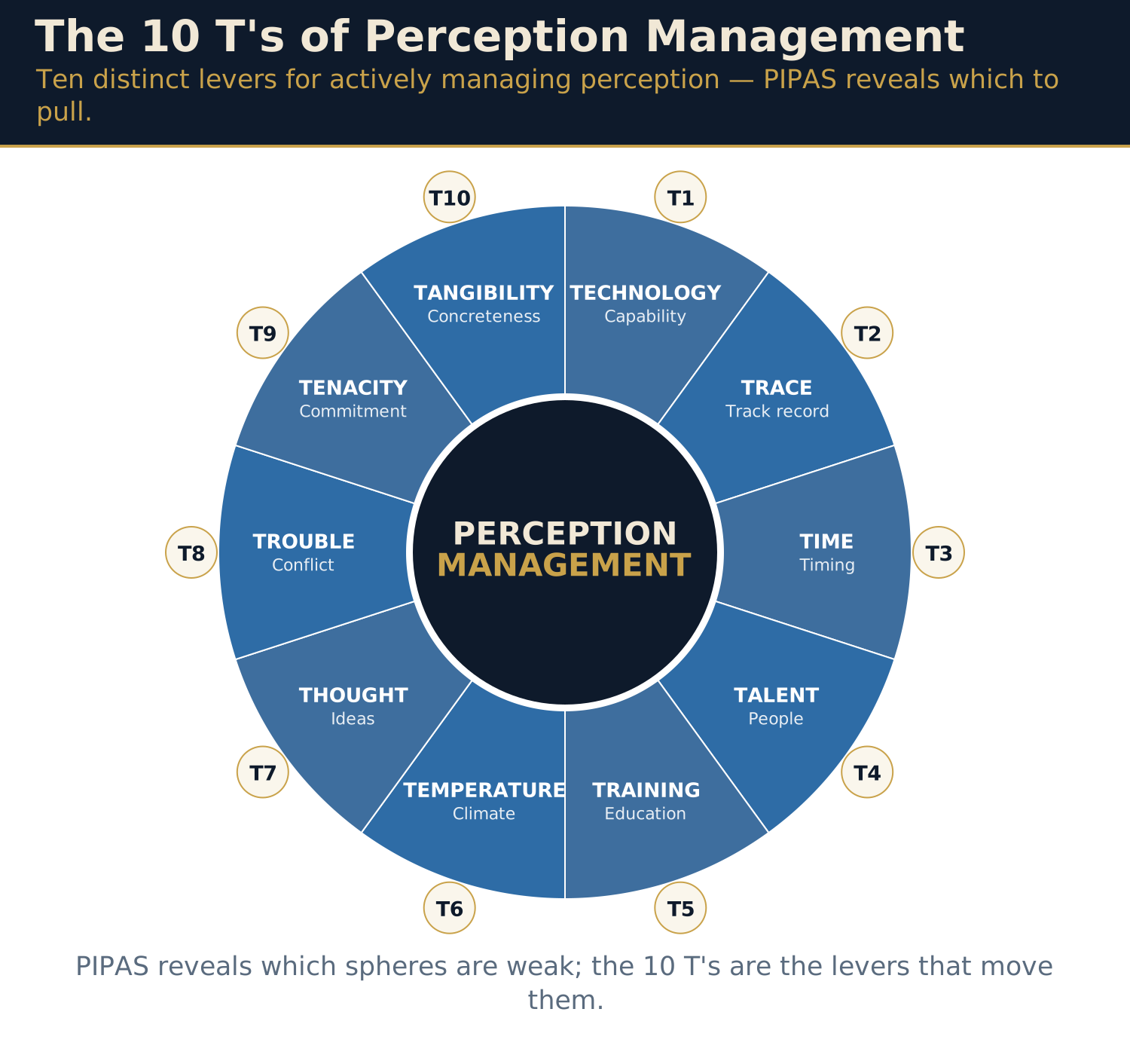
PIPAS is the diagnosis; the 10 T's are the prescription. Five foundation levers, five dynamic levers. Select a lever.
Lower-cost or new-market disruptors displace incumbents through structural market dynamics.
Innovators create uncontested market space rather than competing in saturated waters.
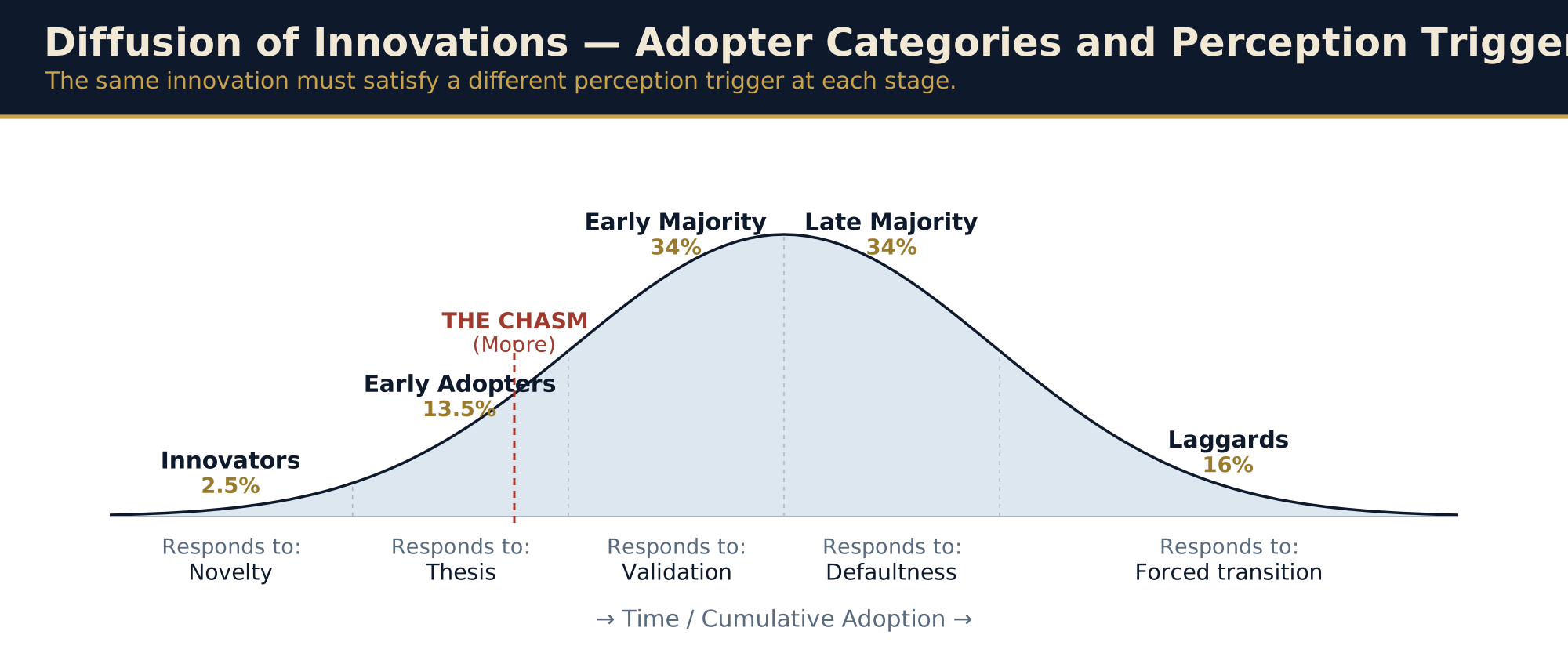
A structural gap separates early adopters from the early majority in technology adoption.
Adoption spreads across populations along characteristic curves.
Methodologies for testing, iterating, and validated learning across hypotheses.
The cognitive mechanisms that make perception, not feature comparison, the dominant driver of decisions.
Format wars, the AI rollout, the crypto winter — three eras, one mechanism. Each is the perception veto operating in plain sight.
Betamax was the superior format, yet by 1988 Sony itself was building VHS units. The PS3 then shipped 10.5M Blu-ray players by 2007 — 15× HD-DVD's base; Toshiba absorbed $986M in losses.
RAND, 2025: 80.3% of AI projects failed to deliver intended value. Of $684B invested, ~$547B fell short — and 42% of companies abandoned initiatives, up from 17% a year earlier.
$3T in cumulative market cap and 820M wallets — roughly 15% of the internet — yet only 12% of US adults use them, and just 7% of informed adults trust wallet safety.
Short enough to force clarity, long enough to build durable capability. Each phase compounds on the last.
Most organisations measure only perception state and financial outcomes — and miss the mechanism in between. The value chain makes it legible.
Six truths summarise what the book argues — uncomfortable for executives trained in conventional innovation thinking, and empirically grounded across decades of cases.
The Betamax-vs-VHS pattern repeats with every generation. The technical winner loses to the perception winner so consistently that the outcome can often be predicted in advance.
Not an art. PIPAS, the 10 T's, the Mental Model Canvas, the Perception Value Chain convert perception from intuition to operational rigour. It can be taught, scaled, sustained.
Successful perception-led implementations spend ~70% of effort on people and process, 20% on infrastructure, 10% on technology. Most organisations invert this. That inversion is the failure.
Each successive wave of innovation produces larger perception challenges than the last. AI agents face hurdles AI assistants didn't. BCIs face challenges immersive headsets didn't.
Unlike technical capability that competitors replicate, perception requires years of organisational learning. The window for early-adopter advantage is the next five to seven years.
Vision Pro, Humane, Rabbit, the parade of stalled enterprise AI deployments — the cases show that ignoring perception produces expensive capital destruction. That destruction is accelerating.
Fifteen chapters, six spheres, ten levers, and forty cases — the complete operating discipline for engineering how innovations are perceived. Every edition includes the forty-eight-sheet Deployment Toolkit and the Perceptive Innovation Skill for Claude, free through the members' Field Kit.
Perception holds the veto.
Perceptive Innovation is stocked by leading booksellers and online retailers across North America, Europe and Asia-Pacific.
Showing 6 stockists worldwide
More stockists in this region are being added as distribution expands.
Any bookshop can order Perceptive Innovation through Ingram, the world’s largest book wholesaler. Quote the ISBN at the counter:
Booksellers and libraries: order through Ingram / IngramSpark, or write to contact@perceptiveinnovation.com for trade terms.
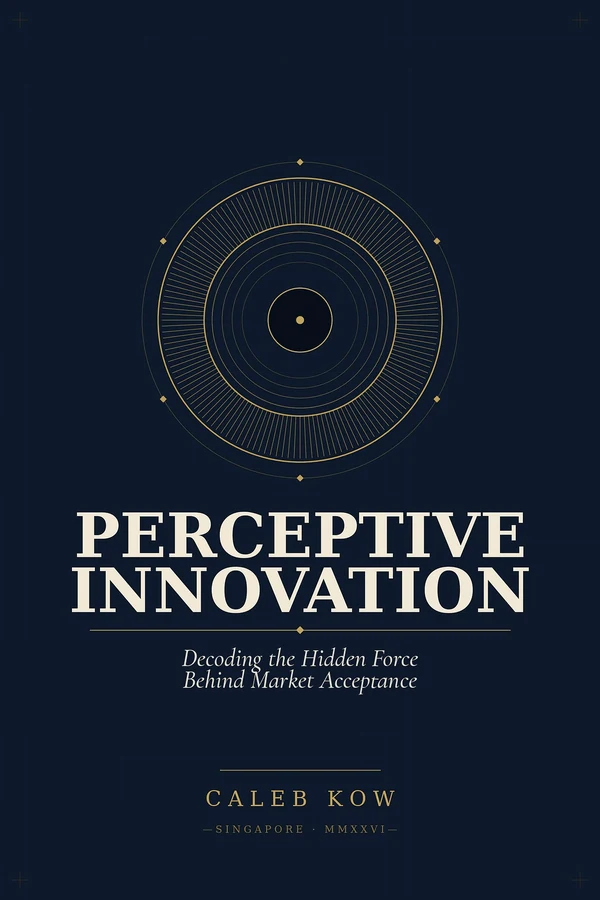
Perceptive Innovation is the operating discipline that engineers how innovations are perceived — across six perception spheres and ten operational levers — so that structurally sound innovations actually get adopted. It was set out by Caleb Kow in Perceptive Innovation: Decoding the Hidden Force Behind Market Acceptance, and treats perception as a strategic discipline rather than a marketing afterthought.
Perception operates probabilistically and integratively, with veto power. It folds everything an audience knows, feels and assumes about an innovation into adoption odds — and a severe failure in a single perception sphere can veto adoption that every other factor supports. Five aligned spheres cannot overrule one misaligned. Perception shapes the odds; it does not determine the outcome.
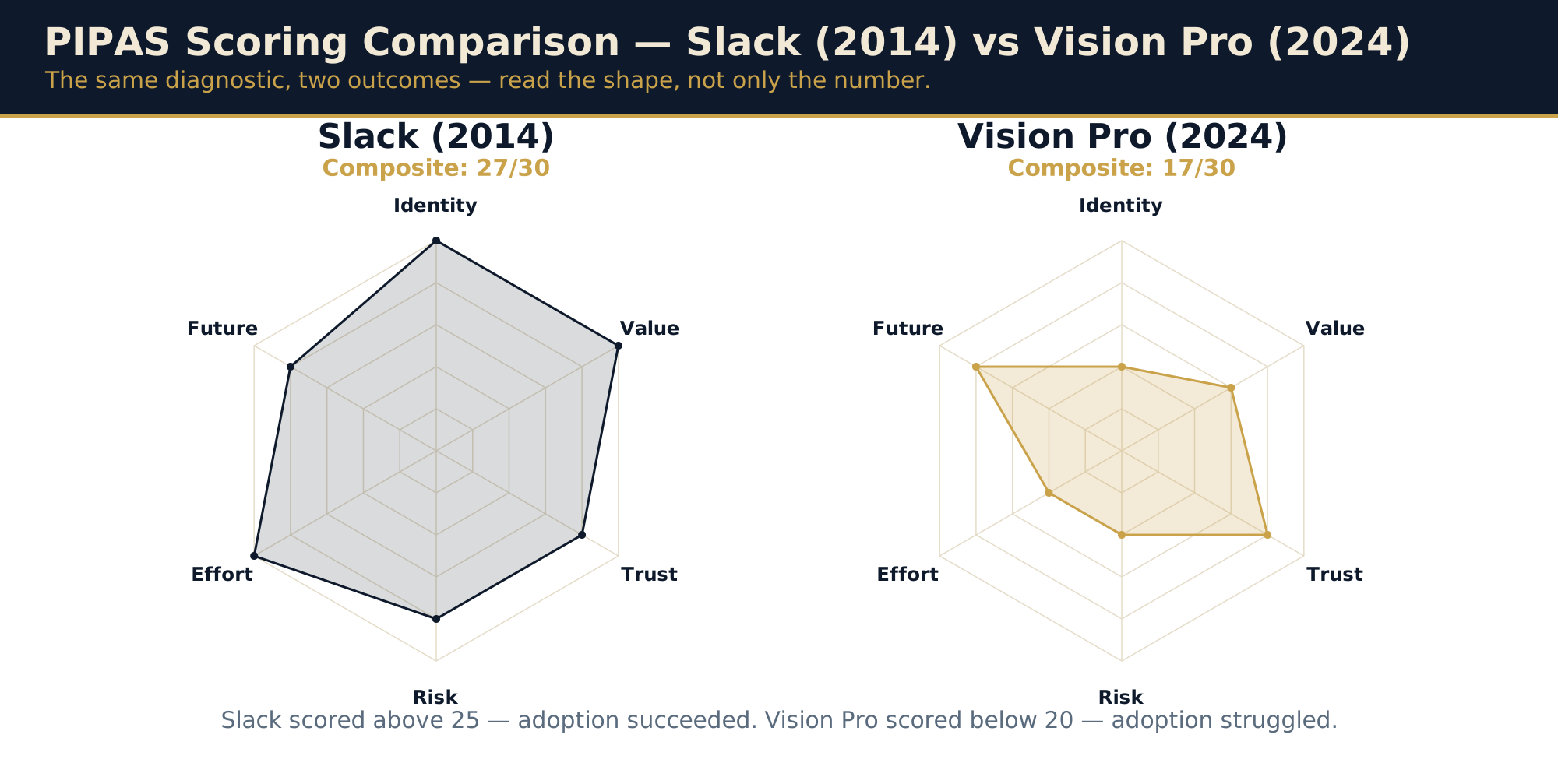
PIPAS — the Perceptive Innovation Project Assessment Sheet — is the diagnostic instrument at the centre of Perceptive Innovation. It scores an innovation, for one named audience, across six perception spheres: Identity, Value, Trust, Risk, Effort and Future. Each sphere is scored 1–5 against evidence; the composite runs 6–30 and is read against four empirical bands.
The six spheres are the psychological filters through which a user asks “should I take this on?” In canonical order: Identity (who I become), Value (what I get), Trust (whether I believe), Risk (what could go wrong), Effort (how hard to adopt) and Future (where this is going). Each returns its own verdict; too many negative verdicts and adoption stalls.
Read the distribution before the composite: find the lowest sphere first. The four bands are empirical: 25–30 Likely Success (the work is execution); 20–24 Watch & Intervene (act on every sphere below 4); 15–19 Rebuild Before Launch (most that launch here fail); 6–14 Restructure or Stop. Any sphere scored 1 is treated as a probable adoption veto.
The 10 T’s are the ten operational levers through which perception is built or damaged, always in canonical order: Technology, Trace, Time, Talent, Training (the foundation levers) and Temperature, Thought, Trouble, Tenacity, Tangibility (the dynamic levers). PIPAS surfaces where perception is weak; the 10 T’s are how a team strengthens it — the prescription that follows the diagnosis.
Diagnosis precedes prescription. PIPAS says where perception is weak; the mapping matrix routes each weak sphere to its primary levers — Identity to Talent, Trace, Thought and Tangibility, for instance. The matrix activates whenever a sphere scores 2 or below. Start at the lowest sphere, choose one or two interventions, attach a metric to each, then re-score.
Many innovations fail not from a lack of technical capability but from a misalignment with human perception. Most of those failures could have been predicted before launch: the signals were visible and the patterns familiar; what was missing was a structured instrument. Perceptive Innovation’s claim is narrower than certainty — with disciplined diagnosis, failure from unanticipated perception challenges becomes rare.
A perception audit is the engagement through which PIPAS and the 10 T’s are applied: one audience, one named decision with an owner and a date, evidence gathered before anyone scores, the sponsor scoring last. The standard unit is a one-day audit that ends with two signed intervention briefs, monitoring hooks and a dated baseline for the next quarter’s re-audit.
It complements them; it does not displace them. Disruption theory explains where an entrant can attack; PIPAS scores whether the audience will perceive the entrant as adoptable. Blue Ocean finds uncontested space; PIPAS tests whether buyers perceive the new value curve. Moore’s chasm is a perception discontinuity — early adopters and the early majority score the same innovation differently.
Innovations that align with existing mental models are subsidised by familiarity; innovations that demand new models are taxed by the effort of building them. The tax can be paid — through demonstration, education and social proof — but it must be budgeted, and most failed innovations underestimate it by an order of magnitude. Three modes rise in friction: alignment, extension, replacement.
Caleb Kow is a Singapore-based innovation technologist with over twenty years across consumer technology, enterprise software, blockchain, financial services and AI, and the author of Perceptive Innovation: Decoding the Hidden Force Behind Market Acceptance (2026). He developed PIPAS after the 2009 collapse of his venture Fonemesh; the six-sphere version has been in use since around 2014.
A reader's companion — not a replacement. Each chapter shows the lede that opens it and the key concepts that anchor it. Bring the book; this is the map.
The most expensive pair of glasses in history cost Google $1,500 to sell and billions in reputation to recall. Three years after launch, the product was dead — not because the technology failed, but because society rejected it with a new vocabulary. We had invented a word for its users: “Glassholes.”
Your brain makes a decision about new technology in 200 milliseconds. Before you have consciously evaluated a single feature, before you have compared specifications, before your rational mind engages, your neural pathways have already voted.
Every format war begins with the death of the same assumption: that engineers will decide it. Engineers prefer technical superiority. Markets prefer perceived value. The gap between them is where billions of dollars vanish.
In 2025, global enterprises invested $684 billion in AI. By year-end, more than $547 billion of that investment — over 80 percent — had failed to deliver intended business value. The technology works. The perception management has been catastrophic.
$3 trillion in cumulative market cap. 820 million wallets globally — about 15% of internet population. Only 12% of US adults use them. Only 7% of informed adults are confident in wallet safety. The largest gap between technical promise and adoption reality in digital technology history.
ChatGPT reached 1 million users in 5 days. 100 million in 2 months. 400 million weekly by 2025. 900 million by February 2026. The fastest consumer technology adoption in history — and not magic. It is the cleanest contemporary demonstration of what perceptive innovation looks like at scale.
Consumers form perceptions in approximately thirty seconds. Those perceptions then act as filters that shape every subsequent interaction. A product that fails the thirty-second filter is dead before it can be evaluated.
Every enterprise software purchase decision has multiple participants but one invisible dominant force: the perceived risk of being wrong. Companies routinely run software they know is suboptimal because the perception cost of switching exceeds the perceived benefit of better alternatives.
Platforms accumulate perception risks that point solutions do not. The same network effects that drive growth in good times accelerate decline when perception turns. A single perception incident can cascade across an entire ecosystem.
Mental models are the cognitive frameworks through which users evaluate every innovation before they evaluate the innovation itself. They are invisible, durable, and decisive. They cannot be ignored, overpowered, or marketed around. They can only be understood and designed for.
The Perceptive Innovation Project Assessment Sheet — PIPAS — is the diagnostic instrument I developed in the years after Fonemesh’s 2009 collapse to systematically evaluate any innovation across six perception spheres before launch. The framework had four spheres originally; Identity and Future were added after observing repeated failure patterns in the engagements that followed.
PIPAS evaluates innovation across six dimensions of perception in the user's mind. The 10 T's evaluate innovation across the actual mechanics through which perception is built or destroyed. PIPAS is the diagnosis. The 10 T's are the prescription.
Most organisations cannot achieve perceptive innovation transformation through annual cycles or quarterly reviews. The change is too significant for incremental approaches and too strategic for episodic interventions. 90 days is the right time horizon — short enough to force clarity, long enough to build durable capability.
Perception management produces measurable financial returns, but the measurement requires frameworks most organisations do not yet use. Most organisations measure only "perception state" and "financial outcomes" — with no visibility into the middle.
Five forces will shape perception dynamics in the decade ahead. Innovators who internalise these forces build perception strategies with longer durability than those who optimise only for current conditions.
From Theory to Practice
Run PIPAS against an innovation you are working on. Open the 10 T's. Cross-reference cases that match your category. The book is the argument; this companion is the workbench.
From Google Glass to ChatGPT, Betamax to Square — the same perception dynamics repeat in different costumes. The full database — every overview, sphere-by-sphere analysis, and lesson, filterable by verdict, industry, and decisive sphere — lives in the members' Field Kit. Free with the book.
Every case in the database. The sphere-by-sphere analysis and the lesson live in the members' Field Kit — each name links to its case.
Each entry gives the overview, the perception analysis, the decisive spheres, and the lesson for innovators — the same structure you'll use to build your own cases in the Field Kit. A sample of the ledger:
Forty-eight printable instrument sheets that take PIPAS from the page into practice — qualifying the engagement, gathering the evidence, scoring the spheres, choosing the levers, and running the quarter. This guide teaches every sheet: how to use it, what good use looks like, and what ruins the reading.
The guide below is open to everyone. Sheet downloads are a members’ benefit — free with any edition of the book.
The kit is not a pile of worksheets. It is one engagement arc: qualify the client, gather the evidence, surface the bias, score the spheres, read the shape, choose the levers, run the quarter — then loop. The facilitation aids stay in the facilitator’s hand throughout; the integration sheets overlay the whole arc wherever the room already thinks in Christensen, Blue Ocean, or Moore.
before day one
Qualify the engagement, map the stakeholders, register assumptions, and request the exact data the audit will stand on.
C-01…C-07 · E-01…E-05View the sheets →opening hour
Surface the technology-first reflex before the framework is named — the room must make the accusation itself.
W-01 · W-02 · W-03View the sheets →the audit core
One innovation, one audience, one named decision; score six spheres on laddered evidence, deep-dive the weak ones.
W-04 · D-01–06 · W-05 · W-06 · W-11 · W-12View the sheets →same session
Distribution before composite; match the shape; convert every two-point dissent into a monitoring hook.
W-07 · W-13 · W-14View the sheets →final hour
Assess the ten levers, then commit: two spheres, one lever each, one quarter — owners, metrics, kill criteria.
W-08 · W-15 · W-09 · W-16View the sheets →the quarter
Book the cadence, track the ninety days, price the ROI, and re-audit against the dated baseline.
W-10 · M-01–03 · A-01View the sheets →The whole arc on one page — orientation for facilitators and first-time teams.
Every sheet, its code, and where it lives in the engagement arc. Codes are stable — cite them in proposals and readouts.
The non-negotiables that keep every sheet honest — read first, and re-read whenever an audit feels too easy.
Break one and the reading stops being a reading. These are the kit’s own non-negotiables, printed on the sheet every engagement starts with.
Perception shapes adoption and holds a probabilistic veto — it never guarantees. Strike absolutes from every readout.
Identity → Value → Trust → Risk → Effort → Future; Technology through Tangibility. Comparability across audits depends on it.
The book’s veterinary case read twenty-three and fifteen on the same day for the same product. An average would have hidden the veto.
No audit without a decision it informs — owner and date on W-03. A reading that informs nothing is theatre.
A rung-1 observation from the most junior voice outranks a rung-5 conviction from the most senior. The sponsor scores last, in writing.
Read the lowest sphere first, then the widest dissent. A twenty-two that is falling is not a twenty-two that is climbing.
One quarter. W-09’s ceiling. If everything is a priority, nothing is.
A sphere scored only on rungs 4–5 stays flagged whatever the number says. Flags convert to monitoring hooks, never to silence.
Every score carries a date and becomes next quarter’s baseline. Write once, use twice.
PIPAS integrates Christensen, Kim & Mauborgne, and Moore. If the kit is used to dismiss those lenses, it is being misused.
Nine series, forty-eight instruments. Select any sheet to open its full training entry — how to run it, what good use looks like, and the misuses that ruin the reading — so the kit trains you, not just equips you.
Every entry below is open — read how every instrument works before you buy. Start with W-01, the reflex test, and W-04, the scoring sheet: the argument in miniature.
Claim your free membership and every button below becomes a download. Print MAP, R-00, and A-03 first — the arc, the rules, and the run sheet for your first audit. Members also take the whole discipline into Claude with the Perceptive Innovation Skill.
Downloads are licensed to members for internal use — your own study, and your own organisation’s innovations. Using the sheets in client engagements, workshops you run for others, or to teach or certify others requires a licence. The sheets remain © Caleb Kow, all rights reserved. Terms & licensing ›
The Toolkit Is the Appendix, Weaponised
The book makes the case and works the forty cases; the toolkit turns it into an operating discipline your team can run quarter after quarter. Every edition of the book includes the full kit — all forty-eight sheets — through the members’ Field Kit.

Decoding the Hidden Force Behind Market Acceptance.
Most innovations don't fail because the technology is weak — they fail because perception casts a veto before the merits are ever weighed. This is the operating discipline for engineering how an innovation is perceived: six perception spheres, ten operational levers, forty documented cases.
Rigorous enough to be credible, clear enough to be useful — the line Christensen and Kim & Mauborgne walked, now applied to the one force most strategy overlooks.
Read any innovation across the six perception spheres and locate exactly where adoption stalls.
Ten operational levers turn diagnosis into a concrete plan you can actually act on.
Twenty failures, fourteen successes, six mixed — exactly what perception did, in detail.
A free online Field Kit turns the framework into a diagnostic you return to over time.
Multiple cases across decades reveal that the answer rarely lies in the technology itself.
It's perception — the hidden force that shapes whether an innovation is adopted or rejected.
Perceptive Innovation gives executives, founders, and investors the operating discipline that engineers perception deliberately — before launch, during execution, and after the verdict — with the same rigour applied to product, pricing, or distribution.
Six spheres for diagnosis. Ten levers for intervention.
Fifteen chapters of theory and evidence, a full diagnostic, the ten levers, and a reference library of real cases — written for intellectually serious operators, not for the airport bookshelf.
The frameworks aren't abstractions — each one is drawn, scored, and worked through.
Diagnose why the market hesitates before you burn another runway, and engineer the perception that unlocks it.
Replace gut-feel positioning with a structured read across six spheres and ten levers you can actually act on.
Pressure-test a thesis against the perception risks that quietly kill structurally sound companies.
Every edition unlocks a free claim to the online Field Kit — the members' diagnostic workspace — the complete forty-eight-sheet Deployment Toolkit, and the Perceptive Innovation Skill for Claude, which puts a working practitioner of the framework inside your own AI conversations. Available on Amazon worldwide.
The reference edition — annotate it, return to it, keep it on the desk.
The durable edition for the shelf you actually point people to.
Kindle edition — start in the next two minutes, claim the Field Kit tonight.
Already have it? Claim your free Field Kit membership › · Prefer a bookshop? See all stockists →
Three working companions come free with any edition — one lives online, one prints for the room, one loads into Claude. Membership takes a minute to claim with the book in hand.
Score your own innovation across the six spheres and the reading is live — saved, dated, and re-scored each quarter so you watch perception move instead of guessing at it.
Forty-eight instrument sheets that run the whole engagement — qualify, gather evidence, score, prescribe, measure — and every one is taught in the open guide before you print it.
A Claude Agent Skill that turns any Claude conversation into a working practitioner of the framework — it interviews you sphere by sphere, reviews your plans and decks against the book, and prescribes the levers. Loads in a minute on any paid Claude plan.

Available on Amazon in paperback, hardcover, and e-book — every edition includes the Field Kit workspace, the forty-eight-sheet Deployment Toolkit, and the Skill for Claude, free.
Perception holds the veto. This book is how you learn to read it — and to engineer it.
The members' workspace that turns the book into practice — score the PIPAS spheres on your own innovation, identify the right levers, and build a living case you return to as perception changes. Free with the book.
Already a member? · Don't have the book yet? Get it on Amazon →
Everything in the book's appendices, made interactive — and a workspace that remembers your work.
Assess Identity, Value, Trust, Risk, Effort and Future on your own innovation and read the composite band — instantly.
The kit maps the levers most relevant to your weakest spheres, so diagnosis flows straight into prescription.
The complete Deployment Toolkit — printable instruments for the whole engagement arc, each taught in the training guide.
Capture the innovation, the alternative, every sphere's reasoning and the lever plan in one structured record.
Perception is not static. Re-score each cycle, keep the history, and watch the trajectory — the book's continuous-monitoring discipline, built in.
Every case is saved to your private library — return any time to update scores or compare against where it began.
Choose to publish a case to the members-only commons, where other readers can view, comment, and help you improve it.
Download the Perceptive Innovation Skill and any Claude conversation becomes a working practitioner — scoring, document review, and prescriptions in the book's own canon, with a members' manual on getting the most from it.
Paperback, hardcover, or e-book on Amazon — any edition qualifies.
Prove ownership with a short question only the book reveals. No codes to lose, nothing to scan.
Create your free membership and start scoring your first case immediately — the Toolkit sheets and the Claude Skill download are waiting inside.
Over twenty years in the works — a discipline, not a manifesto, consolidated from watching innovations succeed and fail.
Across fifteen chapters and a complete operational appendix, Perceptive Innovation argues that perception is the most underappreciated dimension of innovation strategy — and provides systematic frameworks for managing it deliberately.
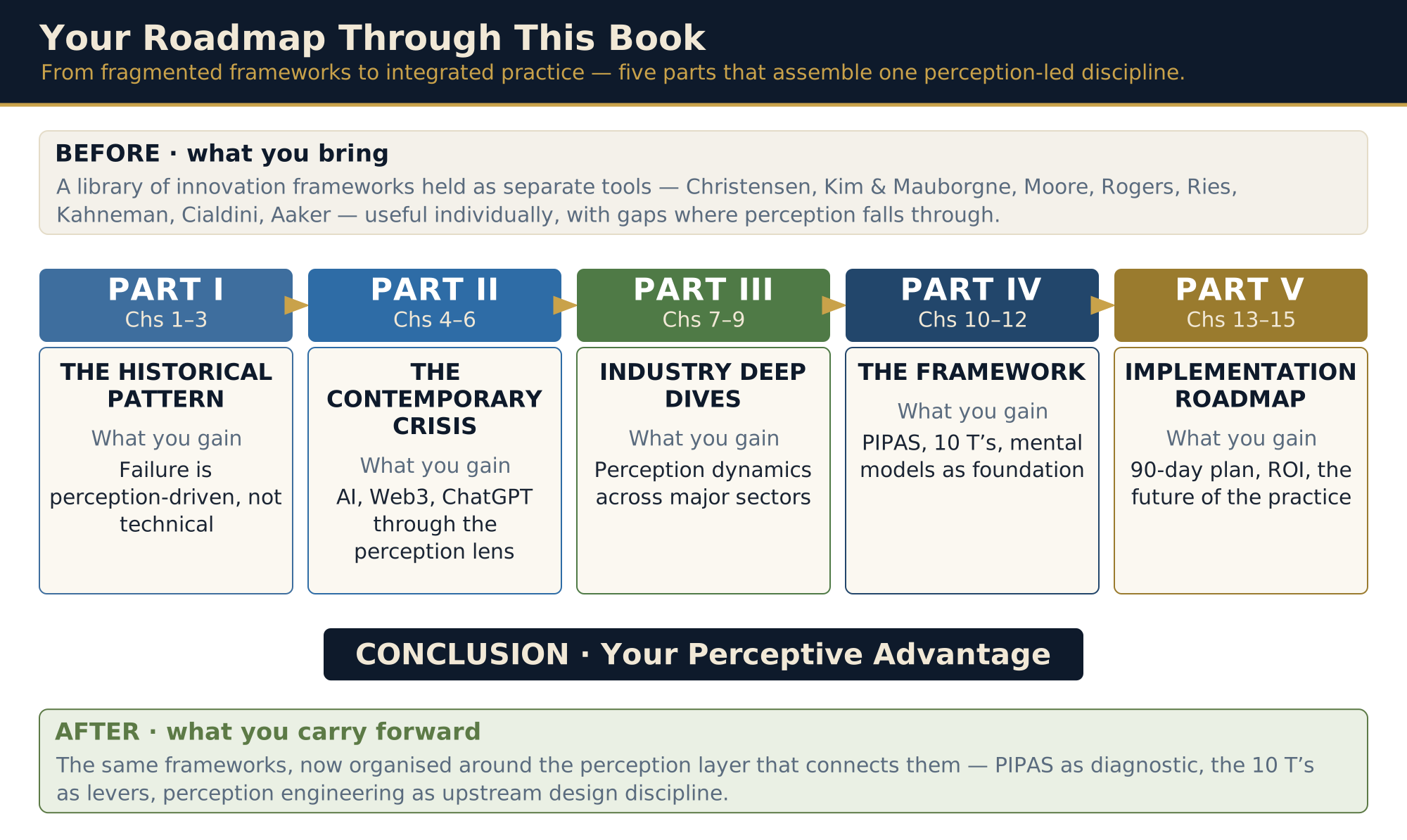
Part I establishes the historical pattern. Part II examines the contemporary crisis in AI and Web3. Part III goes deep on three industries. Part IV develops the framework — mental models, PIPAS, the 10 T's. Part V is implementation.
The argument is structural: the frameworks of Christensen, Kim & Mauborgne, Moore, Rogers, and Ries each illuminate adjacent dimensions. Perceptive Innovation does not displace them. It explains why they work — and provides the operational instrument the canon has always lacked.
Perception should not wear the cape. It should function like Alfred to Bruce Wayne — a quiet, reliable advisor in the background. It does not take over the mission, but it ensures the mission succeeds. You build the capability. Perception ensures it is seen, understood, and adopted.
Every innovator who has read the book now faces a choice.
Conclude perception architecture matters less in your category, that your organisation already handles it sufficiently, or that the frameworks are too elaborate. The frameworks might have improved your outcomes — but you'll never test that hypothesis.
Adopt fragments — PIPAS without the 10 T's, or the 10 T's without the implementation playbook. Selective application produces selective results. Better than nothing. Substantially less than what the system can deliver.
Conclude that perception architecture deserves the strategic priority the book argues for. PIPAS diagnostics, then 10 T's interventions, then the 90-day playbook, then financial integration, then sustained practice. The only path that produces the compounding advantages.
The discipline travels through people, not PDFs. Perceptive Innovation trainers are practitioners certified in PIPAS and the 10 T’s — they run the diagnostic, facilitate the workshop, and stand up the 90-day deployment with your team. Tell us what you need; we route you to the right trainer.
The thesis, live: why superior technology loses to inferior perception — tailored to your industry and made concrete with cases your audience already knows.
A facilitated PIPAS audit and a 90-day deployment: score the six spheres, choose the levers, run the quarter — the Deployment Toolkit, end to end.
Learn to run the method yourself. Certification trains your people — or new independent trainers — to deliver the diagnostic and the deployment to standard.
“Go build something that matters. Use these frameworks to make sure it reaches the people who need it. The world needs more innovators who succeed.”
— Caleb Kow · Singapore · 27 April 2026
Five parts, fifteen chapters. Lede, key concepts, and structure for each.
Six perception spheres. Live composite, banded interpretation, and lever suggestions.
Ten levers, deep-dive on each. Strategic questions and worked examples per lever.
Forty cases with filters. The pattern repeating in different costumes, made unmistakable.
The Perceptive Innovation Project Assessment Sheet. Six spheres, one audience, scored against evidence.
PIPAS is the diagnostic instrument of Perceptive Innovation. It scores an innovation, for one named audience, across six perception spheres — Identity, Value, Trust, Risk, Effort and Future, always in that order — on a 1 to 5 scale, evidence first, number second. The composite runs 6 to 30 and is read against four empirical bands; but the composite is less informative than the distribution, so the first act on any scorecard is to find the lowest sphere. That sphere shapes the odds of adoption more than the five around it. Perception holds the veto.
Diagnosis precedes prescription: PIPAS says where perception is weak; the 10 T’s are how a team strengthens it. The full operating manual is public in the canon — the PIPAS Assessment Manual — and the members’ Field Kit scores, saves and re-scores a case over time.
Who am I if I adopt this? Adoption is rarely just a functional choice — it is a statement, both to the user and to the people around them, about the kind of person they are. Innovations that ask the user to signal an identity they are not comfortable with face uphill adoption regardless of underlying merit.
Levers that shape it: Talent, Trace, Thought, Tangibility.
What does the user perceive they actually get out of adoption, weighed against what they perceive it costs them? Value perception is asymmetric: users heavily discount benefits they cannot picture, and heavily weight costs they can. Single concrete benefits beat feature lists.
Levers that shape it: Technology, Tangibility, Time, Temperature.
Whether the user believes the claims being made. Trust is sphere-specific and claim-specific — a user can trust the brand while distrusting a specific technical claim. Trust scales with verifiability: claims users can independently confirm build durable trust.
The user's intuitive assessment of asymmetry between worst case and best case. Behavioural economics establishes humans weigh losses ~2.5× more heavily than equivalent gains. Engineering reversibility — free trials, money-back, low switching cost back — reduces risk perception.
Levers that shape it: Tangibility, Time, Trace, Trouble.
The user's estimate of how much mental and behavioural effort adoption will require. The brain treats cognitive load as biological cost. If estimated effort exceeds estimated benefit, the user rejects regardless of how brilliant the underlying solution is. "Easier" usually beats "better."
Levers that shape it: Technology, Training, Tangibility, Time.
Whether the user believes the innovation will still be around — and still relevant — long enough to justify the investment of attention. Future perception loops back to identity: will I still recognise myself as someone who adopted this in two years?
Read the distribution before the composite: find the lowest sphere first. Any sphere scored 1 is treated as a probable adoption veto, whatever the total.
Name the audience first. Gather evidence, then score; never let anyone score first and rationalise afterwards. Score leverage audiences — regulators, investors, channel partners — separately when they can block adoption; the lowest cell on the sphere-by-audience matrix outranks every other finding.
From Diagnosis to Prescription
© CALEB KOW · PERCEPTIVE INNOVATION · FIG. 2 THE SIX-SPHERE ORBIT
Five foundation levers. Five dynamic levers. Pulled only after the diagnosis.
PIPAS is the diagnosis; the 10 T’s are the prescription. Each T is a lever an innovator can deliberately work to shape how an innovation is perceived, always in canonical order: Technology, Trace, Time, Talent, Training — the foundation levers, the visible substance — then Temperature, Thought, Trouble, Tenacity, Tangibility — the dynamic levers, perception over time and under adversity. PIPAS surfaces problems but does not resolve them; the levers resolve but do not target. Together they turn perception from something that happens to an innovation into something engineered for it.
The lever reference is public in the canon — the ten levers and the mapping matrix that routes each weak sphere to its levers.
The Technology T captures what users believe about what your innovation can do, how reliably, and how it compares. The critical insight is that technology perception often diverges substantially from technology reality — sometimes more capable than reality, sometimes less. Both create problems.
In the cases: iPhone (2007) — strong, reality matched the demo; Apple Intelligence — weak, demo overreach; DeepSeek R1 — strong, verifiable performance reset perception in 24 hours.
Trace is the perception baggage your innovation carries from previous events — your company, your category, your team's prior work, recent industry news, accumulated user experiences. Trace operates whether innovators acknowledge it or not, and unmanaged Trace can derail otherwise excellent innovations.
In the cases: Stripe — strong, compounded from documentation outward; Web3 industry — weak, accumulated fraud trace at category scale; Microsoft (post-2015) — strong, github + linux + openai rebuilt the trace.
The temporal dimension of perception — when innovations are perceived, how perception evolves over time, how timing decisions affect outcomes. Most innovators dramatically underestimate timing, treating launch dates as scheduling decisions rather than perception strategy.
In the cases: Slack vs Teams — strong, slack designed for immediate value, teams required setup; Apple Watch — mixed, patient repositioning over a decade found health; Vision Pro — weak, launched before perception conditions supported it.
How the people associated with your innovation shape its perception. Talent operates as a multiplier in both directions: associations with respected, accomplished people enhance perception; associations with controversial or unknown people constrain it. Beware "overly-LinkedIn" — exaggerated team perception that operational reality cannot support.
In the cases: Steve Jobs return (1997) — strong, talent perception event before any decisions; Theranos — weak, talent leverage cannot substitute for technical reality; OpenAI team — strong, "built by serious people doing serious ai work".
How users develop the skills, mental models, and operational capabilities they need to use your innovation effectively. Users will reject products they perceive as requiring excessive training, even when actual training requirements are modest. Perception matters more than reality.
In the cases: Salesforce Trailblazer — strong, hundreds of thousands of certified careers; Web3 (early) — weak, documentation written for technical community alone; Stripe Docs — strong, documentation is the marketing.
The environmental conditions in which your innovation is being perceived — broader market context, cultural moment, competitive intensity. Temperature is largely outside any individual innovation's control, but understanding current Temperature shapes strategic timing and positioning.
In the cases: AI category (2025–26) — strong, hot across nearly all dimensions; Web3 (post-2022) — weak, companies that didn't adjust to cooler temperature suffered; ChatGPT launch — strong, created its own temperature.
The ideas, concepts, and narratives that shape how users think about your innovation and the category. Thought leadership is the most prestigious form of marketing. Innovators who shape how their category is conceptualised achieve perception advantages purely product-focused competitors cannot match.
In the cases: Anthropic on AI safety — strong, thought positioning produces enterprise preference; Christensen on disruption — strong, two decades as the dominant lens; Meta in Web2 — weak, lost intellectual leadership to tiktok.
The regulatory, legal, ethical, and reputational challenges your innovation faces and how they are perceived. Trouble operates whether you address it or not. Effectively managed trouble can become perception advantage; ignored trouble compounds in damaging ways.
In the cases: Crypto industry (pre-2022) — weak, treated regulators as adversaries; enforcement wave reshaped industry; COVID-19 supply chain — mixed, companies that communicated transparently kept perception; CrowdStrike (2024) — mixed, transparent response limited the damage.
The perception of your sustained commitment. Customers want assurance the company behind their adoption will continue investing, supporting, and improving the innovation. Particularly important for enterprise software, healthcare, and infrastructure innovations with long adoption cycles.
In the cases: Apple Mac (iPhone era) — strong, 20-year commitment preserved creative platform perception; Google Stadia — weak, customer game libraries became worthless; spillover damage; Salesforce (25+ years) — strong, reinvented through cycles.
How concrete and immediately perceivable the benefits of your innovation are. Abstract benefits resist adoption; tangible benefits drive it. Innovators must make value tangible, particularly when it is structurally abstract.
In the cases: Code completion AI — strong, visible immediately; Strategic decision AI — weak, hard to isolate impact; Square (POS dongle) — strong, card → screen → done.
The matrix activates whenever a sphere scores 2 or below. Two spheres, one lever each, one quarter.
Diagnosis First
© CALEB KOW · PERCEPTIVE INNOVATION · FIG. 3 THE TEN-LEVER WHEEL
How perceptiveinnovation.com collects and processes your personal data. Last updated 26 July 2026.
This policy sets out the basis on which Asia Internet Ventures Pte Ltd, a company incorporated under the laws of Singapore with its registered office address 808 French Road #07-157 Singapore 200808 (Unique Entity Number 201324453K) (together with our subsidiaries, our holding company, subsidiaries of our holding company from time to time, collectively called “Perceptiveinnovation.com” or “we”) collects personal data from you and how we process such data.
By visiting our website perceptiveinnovation.com (our “Site”), you accept and consent to the practices set out below.
This policy covers personal data. Your use of the Site and of the frameworks, materials and marks it publishes — including when a licence is required for commercial use — is governed by our Terms of Use. The Site is operated by Asia Internet Ventures Pte Ltd under licence from Caleb Kow, who is the author of the book and the owner of those frameworks, materials and marks.
1.1 For the purposes outlined in Clause 2, we may collect and process the following information about you:
1.2 We only retain personal data for so long as it is necessary. Data may be archived as long as the purpose for which the data was used still exists.
2.1 We use information held about you for the following purposes:
2.2 We intend to use your personal data in direct marketing (i.e. offering or advertising products or services by sending the relevant information directly to you). We require your consent specifically for this purpose and you may opt out any time. For the purpose of this clause:
We will keep your personal data we hold confidential but you agree we may provide information to:
4.1 Our Site uses cookies to distinguish you from other users of the Site. This helps us to provide you with a good experience when you browse our Site and also allows us to improve our Site.
4.2 A cookie is a small file of letters and numbers that we store on your browser or the hard drive of your computer if you agree to the use of cookies. Cookies contain information that is transferred to your computer’s hard drive.
4.3 We use persistent cookies and session cookies. A persistent cookie stays in your browser and will be read by us when you return to our Site or a partner site that uses our services. Session cookies only last for as long as the session (usually the current visit to a website or a browser session).
4.4 We use the following cookies:
4.5 You can block cookies by activating the setting on your browser that allows you to refuse the setting of all or some cookies. However, if you do so, you may not be able to access all or parts of our Site.
4.6 We may use third-party web services on our Site. The service providers that administer these services use technologies such as cookies (which are likely to be analytical/performance cookies), web server logs and web beacons to help us analyse how visitors use our Site and make the information displayed on it more relevant to your interests. The information collected through these means (including IP addresses) is disclosed to these service providers. We use these services for measurement only; we do not use advertising or targeting cookies, and analytics for EU/UK visitors runs only after consent via the cookie banner.
Our Site or our communication with you may from time to time contain links to third-party websites over which we have no control. If you follow a link to any of these websites, please note that they have their own practices and policies. We encourage you to read the privacy policies or statements of these websites to understand your rights. We accept no responsibility or liability for any practices of third-party websites.
6.1 All information you provide to us is stored on our secure servers.
6.2 All connections to our Site are encrypted using TLS/SSL technology. We do not process payment transactions on our Site — book purchases are completed with the retailer (for example, Amazon) under the retailer’s own terms and security measures.
6.3 Where we have given you (or where you have chosen) a password that enables you to access certain parts of the Site, you are responsible for keeping this password confidential. We ask you not to share a password with anyone.
6.4 We restrict access to personal information to our employees, service providers and contractors on a strictly need-to-know basis and ensure that those persons are subject to contractual confidentiality obligations.
6.5 We review our information collection, storage and processing practices from time to time to guard against unauthorised access, processing or use.
6.6 Please note, however, the transmission of information via the Internet is not completely secure. Although we will do our best to protect your personal data, we cannot guarantee the security of your data transmitted to our Site; any transmission is at your own risk.
7.1 You have the right to:
7.2 Where and only to the extent permitted by applicable law, a request under Clause 7.1 may be subject to a small administrative fee to meet our cost in processing your request. You may also request the correction or deletion of your account and associated data at any time.
We may amend this policy from time to time by posting the updated policy on our Site. By continuing to use our Site after the changes come into effect means that you agree to be bound by the revised policy.
If you have any questions, comments or requests regarding personal data, please address them to:
Privacy Officer, contact@perceptiveinnovation.com
Last updated: 26 July 2026
The terms governing this site, the Field Kit, the Deployment Toolkit, and the licensing of the frameworks. Last updated 26 July 2026.
These terms govern your use of perceptiveinnovation.com and everything it provides — the public site and calculator, the Deployment Toolkit training guide, the members’ Field Kit, the toolkit downloads, and the Perceptive Innovation Skill for Claude. The Site is operated by Asia Internet Ventures Pte Ltd (UEN 201324453K), 808 French Road #07-157, Singapore 200808 (“we”, “us”), under licence from Caleb Kow, who is the author of the Book and the owner of the Frameworks, the Materials, and the Marks. By using the Site you agree to these terms. If you are using the Site on behalf of an organisation, you confirm you may bind that organisation.
In these terms: the Book is Perceptive Innovation: Decoding the Hidden Force Behind Market Acceptance by Caleb Kow; the Site is perceptiveinnovation.com; the Field Kit is the members’ online workspace (case scoring, cycles, the reading library, the commons); the Deployment Toolkit is the collection of forty-eight instrument sheets and their orientation pages, delivered as downloadable files to members; the Guide is the public training guide to those sheets; the Skill is the Perceptive Innovation Skill for Claude supplied to members; and the Commons is the members’ area where shared cases are visible to other members.
In addition:
The public pages — including the thesis, the chapter companion, the Guide, the case index, and the free PIPAS calculator — are provided for your personal study and Internal Use. Calculator scores are computed in your browser and saved only on your device unless you become a member and import them. You may quote brief excerpts of public content with attribution and a link; you may not republish substantial portions, mirror the Site, or extract its content by scraping or automated collection. Commercial Use of the public content and the Frameworks requires a Licence — see section 5.
Field Kit membership is free for readers of the Book and is claimed by answering an in-book verification question. You agree to answer verification truthfully — membership is a benefit of owning the Book, and claiming it without a copy, or helping others do so, is a breach of these terms. Accounts are for one person: don’t share credentials, transfer memberships, or operate more than one account. We may decline, suspend, or revoke membership where verification is abused or these terms are breached.
As a member, we grant you a personal, non-exclusive, non-transferable, revocable licence to use the Deployment Toolkit sheets, the Field Kit and the Skill for Internal Use only. That licence is deliberately practical within its scope: you may print the sheets, complete them, run them on your own innovations, use them with colleagues inside your own organisation, load the Skill into your own Claude account, and cite sheet codes in your internal documents.
It does not extend to Commercial Use. Applying the sheets, the Field Kit or the Skill in engagements, workshops, audits, courses or deliverables for any third party — including clients, prospects, and organisations other than your own — requires a Licence under section 5.
The licence never includes redistribution. You may not: share, host, post, or forward the files themselves (inside or outside your organisation — colleagues with the Book can claim their own membership); share or publish download links; sell, sublicense, rent, or bundle the sheets or the Skill into any product, course, or kit; remove or alter attribution, copyright lines, or notices; create derivative sheet collections for distribution; or use the Materials or the Guide to develop, prompt, fine-tune, or train a competing product, dataset, or machine-learning model. Download links are access-controlled and unique to the members’ area; obtaining or distributing them outside it is unauthorised access.
This licence lasts while your membership stands, and survives for copies you have printed for your own continuing Internal Use. It is a licence, not a transfer: the Materials remain © Caleb Kow, all rights reserved.
Commercial Use of the Frameworks, the Materials, or the Marks requires a Licence. Nothing on this Site, in the Book, in the Field Kit, or in the Toolkit grants one. This applies however you obtained the Frameworks or Materials, and whether or not you charge a fee specifically for the framework element of your work.
By way of example, a Licence is required to: run perception audits, PIPAS assessments, or 10 T’s workshops for clients; deliver training, courses, bootcamps or certification in the Frameworks; offer “Perceptive Innovation”, “PIPAS” or “10 T’s” services, packages or job titles; build the Frameworks into software, a template library, an assessment tool, an agent or a model; or publish paid material, tooling, or derivative instruments based on them.
The Marks. You may not use the Marks in a business, product, service, course, certification, publication, domain name, social handle, or marketing material, or in any way that suggests affiliation, endorsement, accreditation, or that we trained or certified you. Certification and trainer status are granted only in writing.
What you may always do without a Licence. Read, learn, and apply the Frameworks in Internal Use. Refer to the Frameworks and the Book by name in ordinary descriptive, editorial, review, journalistic, or academic contexts, with attribution — including quoting brief excerpts and citing the Book in research and coursework. Say accurately that your own thinking or work draws on Perceptive Innovation, provided you do not imply that we endorsed, certified, or supplied it. Search engines and AI assistants are welcome to index the public pages and to quote the Frameworks in answers, with attribution to Caleb Kow — a machine-readable account is published at /llms.txt. This welcome is not a Licence for Commercial Use and does not extend to the gated Materials. This section is not intended to restrict fair dealing, fair use, or other rights that apply by law.
Getting a Licence. Licensing, trainer accreditation, and certification run through contact@perceptiveinnovation.com and the Work with us page. We would rather license the practice than police it — tell us what you want to do and we will tell you what it takes.
No licence by implication. No Licence arises from your purchase of the Book, your membership, your download of any Material, our silence, or our failure to enforce these terms on any occasion. A Licence is granted only in a signed writing, and only by Caleb Kow.
You retain ownership of the cases, scores, cycles, notes, and comments you create. By choosing to share a case to the Commons, you grant other members permission to view and comment on it, and you grant us permission to display it within the Field Kit; this permission ends when you unshare or delete the case, except for moderation records we reasonably retain. You’re responsible for what you post: don’t submit unlawful, infringing, confidential, or abusive content, and don’t post information about identifiable third parties without the right to do so. We may moderate, hide, or remove shared content and may suspend accounts that breach these terms. The Field Kit is a working tool, not an archival service — keep your own records of anything critical.
You agree not to: circumvent or probe the membership gating, verification, or download controls; access the Site by bots, scrapers, or bulk automation (indexing of public pages by search engines and AI assistants excepted); interfere with the Site’s operation or its providers; misrepresent your identity, affiliation, or accreditation; offer Commercial Use services without a Licence; or use the Site to build or seed a competing database, kit, model, or service. We may rate-limit, block, or suspend access that we reasonably believe breaches this section.
The Book is sold by Amazon and other retailers, not by this Site. Your purchase is governed by the retailer’s terms; we don’t process payments, returns, or refunds. Membership, the Toolkit and the Skill are benefits attached to the Book, not products sold separately, and their availability is described on the Site at the time you claim them. Buying the Book conveys the ordinary rights of a book owner — it does not convey a Licence.
Our Privacy Policy describes what we collect and why, including aggregate analytics and — for members — a record of which toolkit sheets you download, used in aggregate to understand which instruments are most useful. These terms incorporate it. The Site uses cookies — including Google Analytics, with a consent choice for visitors in the EU and UK. The brand film at the top of the home page is served from our own infrastructure; it is not a third-party embed.
The Book, the Frameworks, the Materials, and the Marks are © Caleb Kow, all rights reserved, and are protected by copyright, database, trade mark and unfair-competition laws. Asia Internet Ventures Pte Ltd operates the Site and delivers the Materials under licence from him. Nothing in these terms transfers ownership to you or grants any right by implication, estoppel, or otherwise beyond the limited licences expressly stated in sections 2, 4 and 6.
Copyright and attribution notices form part of the Materials: do not remove, obscure, crop, or alter them, including in printed copies, screenshots, and slides. Where you reproduce a diagram or sheet under a permitted use, keep the © line intact and legible.
If you believe something on the Site infringes your rights, write to contact@perceptiveinnovation.com with the details and we will look into it promptly.
The Frameworks, the calculator, the Field Kit, the Skill, and the Toolkit are educational and diagnostic instruments. Perception shapes adoption; it holds a probabilistic veto — no reading, band, or score is a promise about what the market will do, and none of this is investment, legal, accounting, or other professional advice. Readings inform your judgement; decisions, and their outcomes, remain yours.
We may add, change, or retire features of the Site, the Field Kit, the Skill, and the Toolkit, and we don’t promise uninterrupted availability — the members’ area depends on third-party services (hosting, authentication, storage), and the public Site relies on third parties for hosting, content delivery, and analytics, any of which can fail or change. We may suspend or terminate access for breach of these terms. If your membership ends, your licence to gated content ends with it (printed sheets you already use survive, per section 4); where practical we’ll give you the opportunity to export the cases you created.
The Site, the Field Kit, the Skill, and the Toolkit are provided “as is” and “as available”, without warranties of any kind, express or implied. To the maximum extent permitted by law, we are not liable for indirect, incidental, special, or consequential losses, lost profits, lost data, or business interruption arising from use of the Site, and our total liability for any claim is limited to the amount you paid us for the Site — which, today, is nothing. Nothing in these terms excludes liability that cannot be excluded by law.
These terms are governed by the laws of Singapore, and the courts of Singapore have exclusive jurisdiction. We may update these terms as the Site evolves; the date above reflects the latest revision, material changes will be noted on this page, and continued use after a change means you accept it. If any part of these terms is found unenforceable, the rest stands.
This revision states plainly what previously had to be inferred: Commercial Use of the Frameworks, Materials, and Marks requires a Licence (section 5), and the member licence in section 4 covers Internal Use. The earlier wording described toolkit sheets as usable in “client engagements and workshops you run”; that use now needs a Licence, which we grant readily — if you have been using the sheets with clients, write to us and we will sort out a licence rather than ask you to stop. Definitions of Frameworks, Materials, Marks, Internal Use and Commercial Use are new, and the operator of the Site is now identified.
Questions? contact@perceptiveinnovation.com

The link may be mistyped or retired. Here's the way back.